
Surrogate modeling & model reduction
Cross-
Cutting
Research Area
Harnessing the data through the lens of physics-based modeling
Scientific Machine Learning brings together the complementary perspectives of computational science and computer science to craft a new generation of machine learning methods for complex applications across science and engineering. In these applications, dynamics are complex and multiscale, data are sparse and expensive to acquire, decisions have high consequence, and uncertainty quantification is essential. The greatest challenges facing society — clean energy, climate change, sustainable urban infrastructure, access to clean water, personalized medicine and more — by their very nature require predictions that go well beyond the available data. Scientific machine learning achieves this by incorporating the predictive power, interpretability and domain knowledge of physics-based models.

The applications are characterized by complex multiscale multiphysics dynamics, so that small changes in parameters can lead to large changes in system behavior.

The parameter space is very high dimensional. Many parameters of interest are fields (infinite dimensional). Without the constraints of physics, the solution space is so vast that driving decisions with data alone is doomed to failure.

Data are sparse and typically rely on physical sensing infrastructure, making them expensive to acquire. Data may be large in volume, but they provide only limited peeks into the underlying high-dimensional parameter space.

Uncertainty quantification of predictions must provide quantified confidence in the recommended decisions. This is especially challenging but especially important as we extrapolate beyond the data to issue predictions about future states.
Research is multifaceted, ranging from foundational advances in theory, methods and algorithms, to real-world impact in societal grand challenge problems.
Surrogate modeling & model reduction

Bayesian inverse problems

Physics-informed deep learning

Data assimilation

Interpretable machine learning

Reinforcement learning

Digital twins

Optimal experimental design
The Oden Institute and The Alan Turing Institute have a memorandum of understanding to collaborate in the areas of artificial intelligence for science and engineering, computational science and engineering, scientific machine learning, and data-centric engineering. Established in 2015, The Alan Turing Institute is a high-profile, vibrant and multidisciplinary national institute, bringing together 13 leading universities from England and Scotland, making it the UK’s national institute for data science and artificial intelligence.
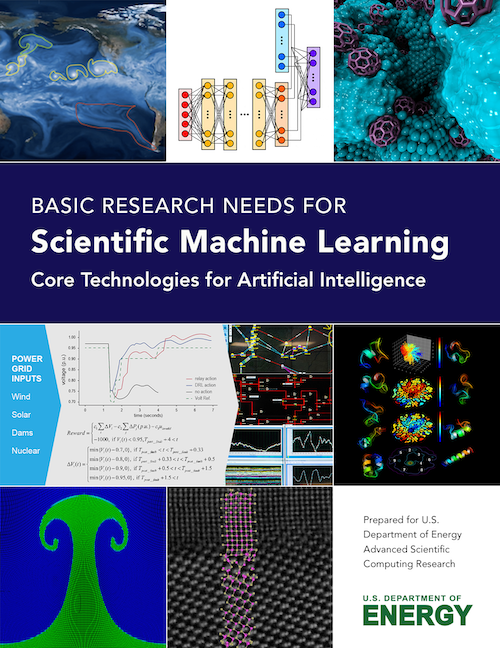
The Oden Institute's Center for Scientific Machine Learning has strong collaborations with Department of Energy programs, including the AEOLUS Multifaceted Mathematics Integrated Capability Center, the ARPA-E DIFFERENTIATE program for design intelligence, and the Artificial Intelligence and Decision Support for Complex Systems program. Our faculty also played a key role in the ASCR visioning report on Basic Research Needs for Scientific Machine Learning
.To learn more about projects and people in Scientific Machine Learning, explore the centers and groups with research activities in this cross-cutting research area.
Center for Scientific Machine Learning
Optimization, Inversion, Machine Learning, and Uncertainty for Complex Systems
Computational Research in Ice and Ocean Systems Group
Probabilistic and High Order Inference, Computation, Estimation, and Simulation
Profile
Oct. 15, 2026
Peter O’Donnell, Jr. Postdoctoral Fellow Jingqi Li's research addresses the question of how machines coordinate as naturally as people using game theory, optimization, and deep reinforcement learning as tools for understanding strategic interaction and uncertainty.
News
Oct. 14, 2026
A three-year project led by UT faculty Joshua Burby will build neural network models to explore new stellarator designs and lower the cost of future fusion power plants

News
Aug. 20, 2026
In a recent paper a team of researchers, including Professor Patrick Heimbach and Ph.D. student Joseph Kump, introduced a new framework for simulating components of the Earth. To demonstrate the framework’s versatility, the team tested it on four different Earth component models including an idealized ocean model of the Drake Passage.