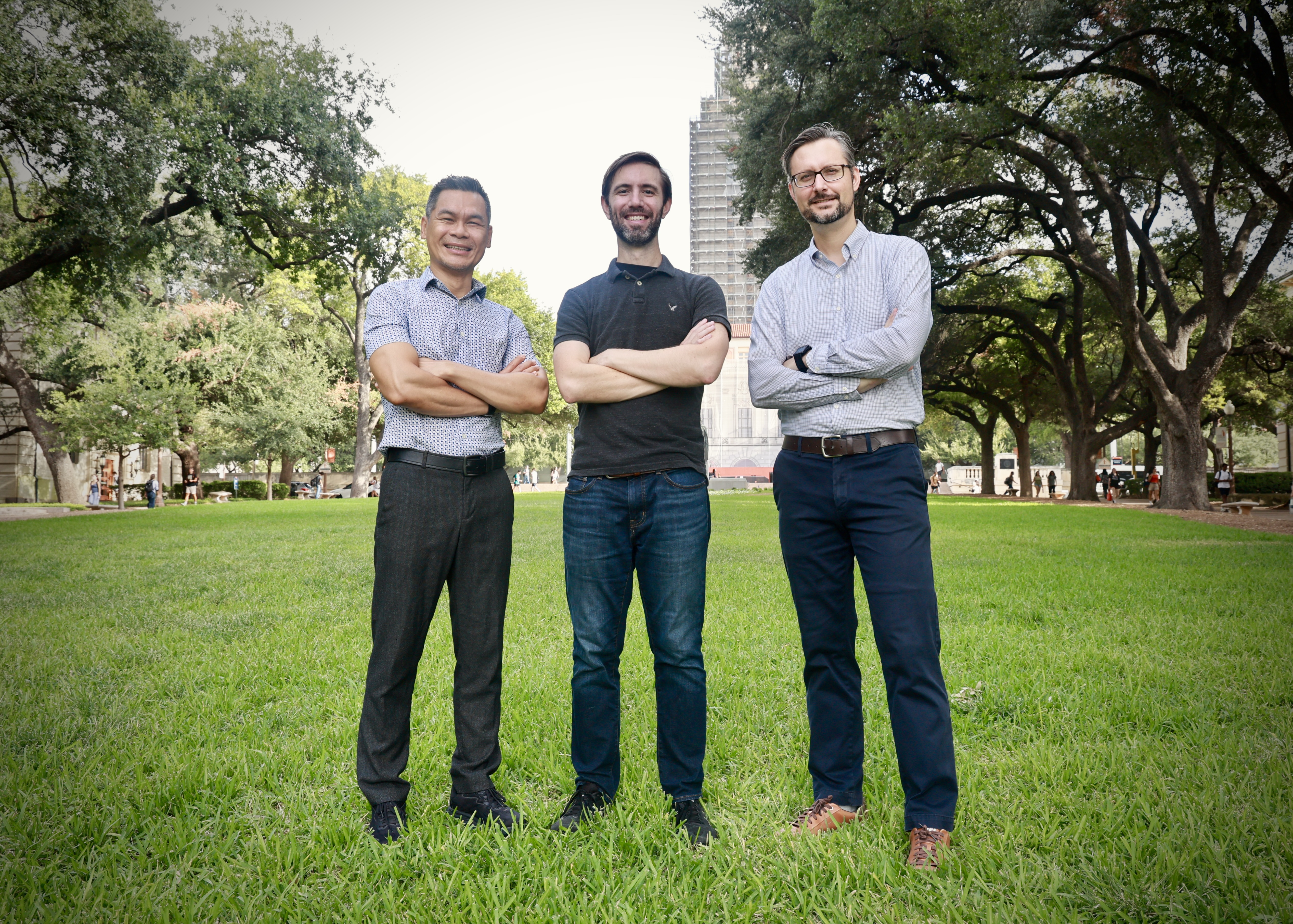
A team led by Joshua Burby, assistant professor of physics in the College of Natural Sciences and affiliated faculty member at the Oden Institute for Computational Engineering and Sciences at The University of Texas at Austin, has been selected as a recipient of the Google.org Impact Challenge: AI for Science. The team, which also includes researchers at the University of Washington and New York University, will receive funding over three years with support from Google.org, to develop neural network models to speed up the design of compact stellarator fusion reactors.
Why stellarators are hard to design
Fusion energy could provide abundant, carbon-free power, but turning it into a working power plant is a major engineering challenge. Stellarators are one promising reactor design. A stellarator is a machine that uses precisely shaped magnetic fields to hold the superheated plasma that fuels fusion in place. Shaped like a donut that has been twisted, a stellarator is asymmetrical and looks different from every angle. That makes every design a complicated puzzle and expensive to test with computer simulations.
To find a good design, researchers run high-fidelity simulations of how heat and particles move within the reactor, repeatedly, while they optimize the shape of the surrounding magnetic field that contains the plasma. But these simulations are slow and costly to run. The team will build neural network models, known as surrogate models, that take over most of those repeated calculations faster and more affordably. With these models, researchers can search a much larger range of designs to identify reactor candidates that are economically attractive. The new designs have the potential to dramatically lower construction costs for future fusion power plants.
The team is focusing on high-beta designs, where the plasma pressure is a relatively large fraction of the magnetic pressure. In this scenario, the plasma itself has a stronger effect on the magnetic configuration, so the plasma equilibrium and the transport of heat and particles must be considered together.
“We theorists like to assume an orderly confining magnetic field, but at high-beta the plasma doesn’t care what we assume. If the plasma sees an opportunity to sew chaos, it usually takes it. The unruly nature of these types of plasmas forces us to adopt fundamentally new approaches. Without the computational acceleration provided by AI, these new approaches would be too cumbersome,” explained Burby.
The team
Burby is the principal investigator (PI) on the project. His co-PIs are Tan Bui-Thanh, professor of aerospace engineering and engineering mechanics and core faculty member at the Oden Institute, who leads the machine learning work, and David Hatch, research associate professor of physics at the Institute for Fusion Studies, who leads high-performance computing.
Additional members of the team include Alan Kaptanoglu, assistant professor of aeronautics and astronautics at the University of Washington, who leads optimization, and Tobias Blickhan, faculty fellow at the Courant Institute of Mathematical Sciences at New York University, who leads equilibrium computation. Additional collaborators include MJ Pueschel of the Dutch Institute for Fundamental Energy Research, Noah Mandell and Antoine Cerfon of Type One Energy, and Michael Kotschenreuther of ExoFusion and UT’s Institute for Fusion Studies.
“This award gives us an opportunity to push scientific machine learning into a difficult multiphysics design problem where accuracy, generalization, uncertainty, and physical consistency all matter. It builds directly on the Oden Institute’s work in model-constrained scientific machine learning and lets us develop methods that can make expensive computational science useful in real-time design and decision making,” said Bui-Thanh.
“We’re at an extraordinary moment for science, as advances in AI open up new possibilities for discovery that were difficult to imagine just a few years ago,” said Leslie Yeh, Director of Scientific Progress, Google.org. “The University of Texas at Austin is bringing together AI and deep scientific expertise in ambitious, creative ways to address some of humanity’s most important questions. We’re honored to support their work as they apply AI to the design of compact fusion reactors to push the boundaries of scientific discovery and turn breakthrough ideas into real-world impact.”
Building on fusion research at UT
The project builds directly on the Oden Institute’s research in model-constrained scientific machine learning. Burby is also a principal investigator on one of four seed projects that the Oden Institute and the Institute for Fusion Studies recently launched.
According the Burby, the project aims to design new stellarator configurations that are not currently accessible to existing design tools and ensure model consistency. All machine learning models and agentic workflows produced by the project will be available in open-source repositories. Project funds will support three new postdoctoral researchers at UT Austin and one new postdoctoral researcher at The University of Washington.
UT Austin is one of 17 organizations selected globally from more than 3,000 applicants across 30 countries to share $36 million in funding. Recipients also receive Google Cloud credits and join a six-month Google.org accelerator with hands-on support from Google AI experts. The google accelerator program is designed to rapidly scale their proposed AI solutions over a six-month period. As part of the program, Google employees Nova Fallen and Edouard Gahou will provide the team with research and engineering support.
About the Oden Institute for Computational Engineering and Sciences
The Oden Institute at The University of Texas at Austin is an interdisciplinary research unit that advances computational science, engineering, and mathematics to address grand challenge problems facing society. The Institute brings together 146 affiliated faculty from 27 academic departments across campus.
About the Impact Challenge
The Impact Challenge supports recipients worldwide that are using AI to tackle complex scientific challenges. Learn more and meet all 17 recipients here.
For media inquiries, contact Joanne Foote, communications director at the Oden Institute, at jfoote@oden.utexas.edu or Marc Airhart, assistant director of communications at the College of Natural Sciences, at mairhart@austin.utexas.edu.