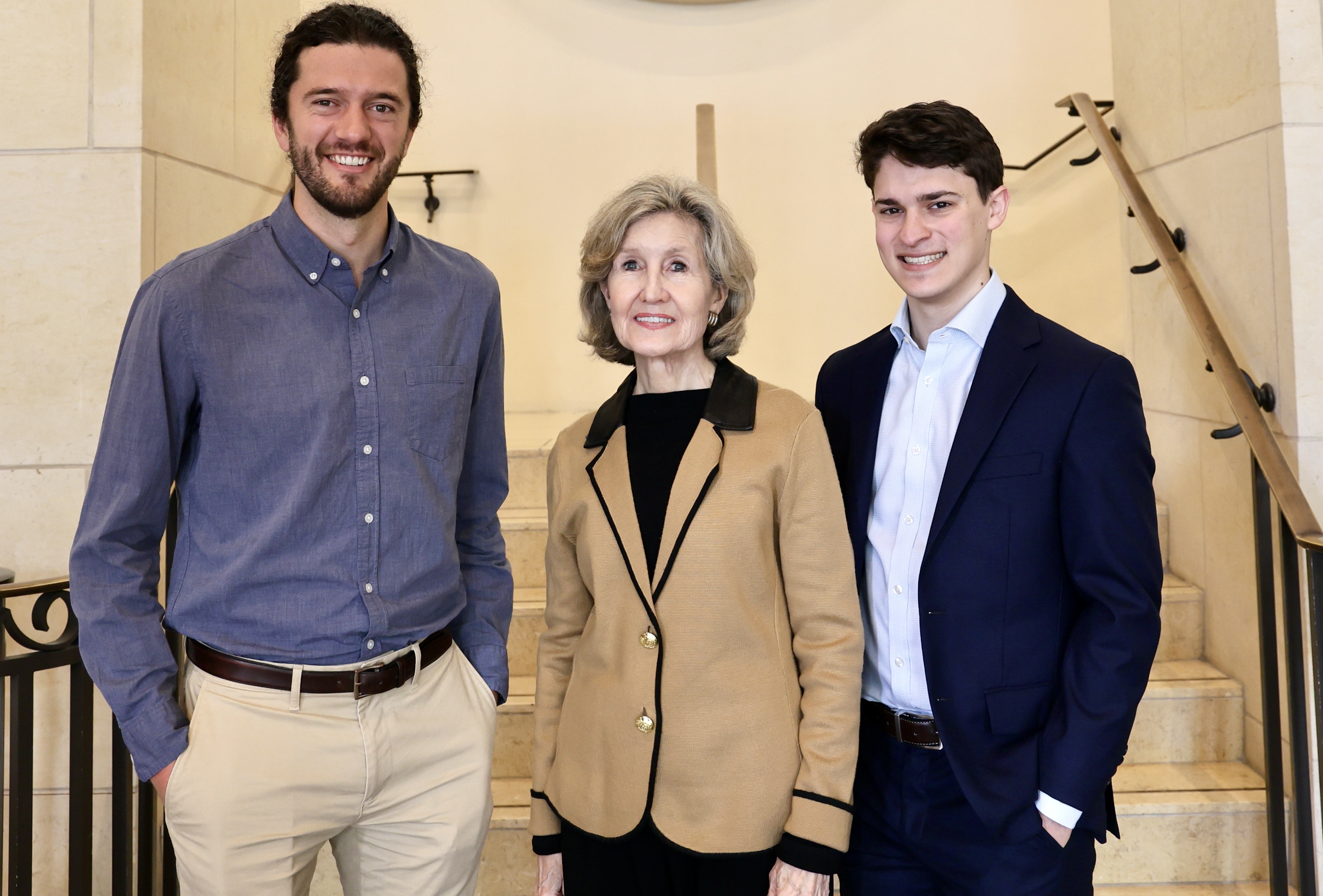
Benjamin Zastrow
Benjamin Zastrow, a graduate researcher working with Professor Karen Willcox, director of the Oden Institute, focuses on digital twins, reduced-order modeling, and uncertainty quantification. His research develops computational tools that are both fast enough and reliable enough to support real-time decision-making in large-scale energy systems.
Zastrow sees digital twins as one of the most impactful ways computational science connects directly to real-world energy systems. Drawing on his research with TotalEnergies on wind farm energy forecasting, and earlier work on nuclear reactor control systems at Idaho National Laboratory, he studies how virtual models can mirror and improve physical energy infrastructure. “Digital twins allow us to make accurate predictions and decisions about a system in real time,” he said. “Every turbine in a wind farm might get its own digital twin, allowing us to tailor the maintenance schedule, control algorithms, and energy yield predictions to the specific conditions experienced by that specific turbine.”
To enable this kind of real-time insight, Zastrow develops methods that make complex simulations faster and more reliable. “Reduced-order models can accelerate expensive predictions, from taking hours to taking just minutes or seconds, with only small losses in accuracy,” he explained. Paired with uncertainty quantification, these tools help engineers understand how much confidence to place in predictions when real-world conditions are uncertain.
His work sits at the convergence of traditional physics-based modeling and modern machine learning. Rather than choosing between the two approaches, Zastrow develops methods that combine them. “Scientific machine learning tries to get the best of both worlds by starting with the physics we already know and then augmenting that knowledge with AI where it is helpful,” he said.