University of Texas at Austin

News

UT Professor Michael Sacks Named Recipient of the 2026 H.R. Lissner Medal for Contributions to Heart Valve Simulations

By Joanne Foote

Published Dec. 10, 2025

Professor Michael Sacks, a biomedical engineering faculty member at The University of Texas at Austin, has been awarded the 2026 ASME H.R. Lissner Medal in recognition of his “pioneering contributions to heart valve biomechanics utilizing highly innovative computer simulations.” His research bridges the cellular, tissue, and organ levels focused on restoration of normal function. The H.R. Lissner Medal is a prestigious society-level honor from the American Society of Mechanical Engineers (ASME), recognized as the highest award bestowed by ASME's Bioengineering Division. 

As director of the Willerson Center for Cardiovascular Modeling and Simulation and principal faculty member at the Oden Institute for Computational Engineering and Sciences at UT, Sacks is an established pioneer in the mechanics of heart valves, with a focus on modelling disease mechanisms and developing rational simulation-based approaches for their functional restoration.

“This award is very important to me personally, as it recognizes nearly 15 years of concerted efforts at UT, and specifically at the Oden Institute's Willerson Center, in the study of deadly mitral valve and other heart valve diseases to develop new methods to improve treatment,” said Sacks.

Heart valve disease is projected to rise sharply with an aging population. Heart valves - structures within the heart that function like one-way gates—ensure that blood moves forward in the correct direction with each heartbeat. When those valves are compromised, the heart can become strained and lead to heart valve diseases.

The primary focus for Sacks and his research team at the Willerson Center involves using an innovative approach to integrate multi-scale simulation methods—from cellular to organ level—to advance patient-specific computational models for mitral valve (MV) surgical repair to treat MV regurgitation—a result of tissue degeneration or myocardial infarction. While MV repair remains the preferred treatment, long-term outcomes remain subpar and difficult to predict.
 

block.caption

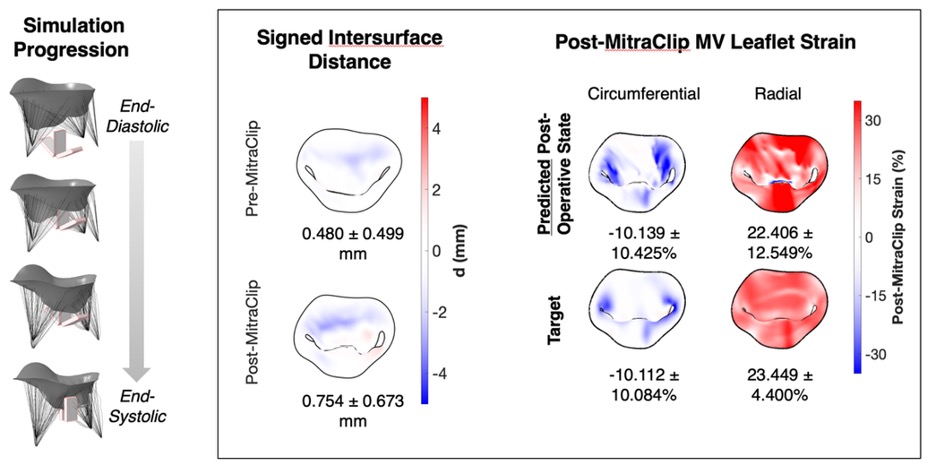
Patient specific simulation of MV edge-to-edge repair demonstrating <1 mm error with the postoperative geometry and close agreement in the circumferential and radial strain fields. Demonstrating that MV repair outcomes can be computationally predicted.


The team is advancing new, noninvasive ways to accurately simulate how a mitral valve (MV) repair will work using medical images taken before surgery. These individualized computer models are built on a detailed understanding of how the valve normally moves and functions, including the novel use of MV residual tensions to help the model match the shape the valve should have when the heart is fully contracted.

The resulting MV simulations of the repaired geometries were accurate to within <1 mm of the target. This approach is now being applied clinically in cooperation with several medical centers through a start-up company. The goal is to establish optimal methods for more durable repairs in a pre-clinical surgical setting.  

“Our group is also working towards clinical interpretation of this modeling approach by developing a mitral valve digital twin,” said Sacks. A digital twin utilizes current and future clinical data which continually updates predictive mitral valve models that are patient specific.

To create this MV digital twin, the research team is building a novel neural network-based method integrated with finite elements (NNFE). The NNFE approach is being used for many-query simulations to obtain patient-specific optimal repair strategies in clinically relevant timeframes.

Looking ahead, Professor Sacks is advancing efforts to uncover the cellular mechanisms that drive heart valve disease, using computational tools to ultimately pave the way for non-surgical treatment options. At the same time, his team is discovering new modeling strategies for next-generation valve replacements. While today’s replacement heart valves support longer lifespans for patients, they still have durability issues. By reengineering how replacement valves are designed and function, he and and his collaborators aim to help move the field toward safer, more effective alternatives.

Established in 1977 as a divisional award, The H.R. Lissner Medal was upgraded to an ASME society-level award in 1987. The Medal will be presented at the World Congress of Biomechanics in Vancouver, Canada in July 2026.