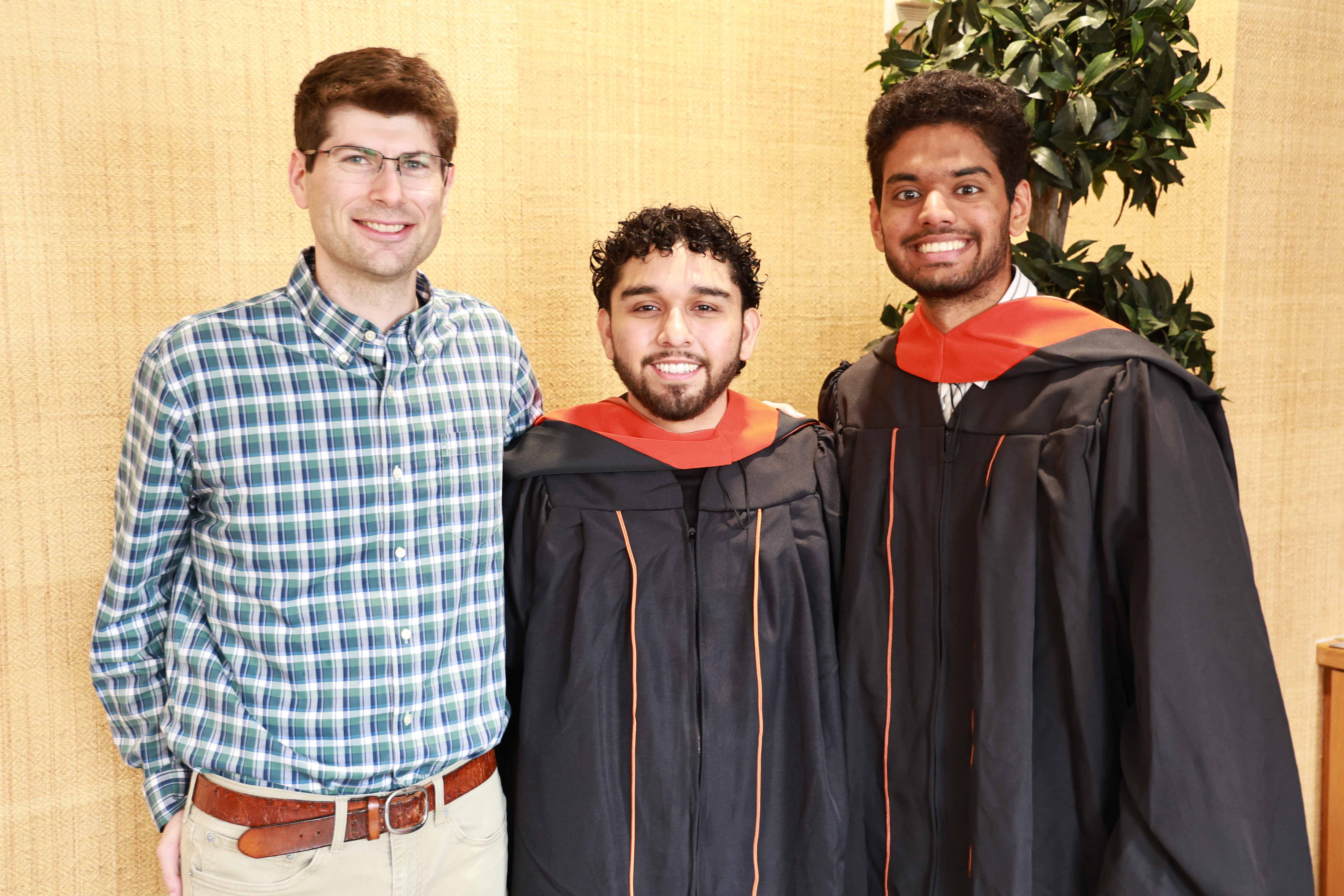
“What starts here changes the world.” If you have spent time on the 40 acres, you have likely seen that motto across The University of Texas at Austin campus. For two students in the first cohort of the 5-year Computational Engineering BS/MS program, those words ring true.
Antonio Jimenez and Atharva Kalamkar were the first to graduate from a new integrated program where students earn a Bachelor of Science in Computational Engineering (B.S., COE) at the Cockrell School of Engineering and a Master of Science in Computational Science, Engineering, and Mathematics (M.S., CSEM) at the Oden Institute for Computational Engineering and Sciences. “I felt a mix of excitement and fear,” Atharva said about participating in the first cohort. “It was scary because no one had done it before, but at the same time, it was exciting because it was a direct continuation of my bachelor’s.” Antonio also echoed this sentiment — he was initially lured by free pizza at the information session, but stayed because he was drawn to “diving deeper into what computational science is.”
The degree prioritizes interdisciplinary exposure to applied mathematics, scientific computation, and discipline-specific modeling. Students take courses in three areas — applied mathematics, numerical analysis and scientific computation, and mathematical modeling and applications — providing a holistic view of technical challenges. As Atharva puts it, “The biggest thing about this integrated major was that I was able to see different engineering problems in 3D: design, develop, and deploy. This 3D experience is something you can only get with an integrated program like CSEM.”
This meant that, in some of their classes, they could participate in every stage from concept to real-world application. One class that stood out to both of them was a graduate elective that teaches how to use neural networks to model biomechanical systems. Despite arriving with little knowledge of how the heart works, by the end of the course, they had a working machine-learning heart model.
But before any of their graduate courses, the pair had already met during their senior design class, where they were placed into a project with Oden-affiliated faculty member John-Paul Clarke. Clarke, a former track athlete, has officiated track and field events at every level, from high school competitions to the Olympics, so he pitched an idea to build a drone-based umpire system to detect lane violations (instances when an athlete steps outside their lane).
This responsibility is usually handled either by human umpires — who are often understaffed, working in extreme heat, and juggling multiple tasks — or by costly sensor systems that are out of reach for many organizations. For high-stakes races like the Olympics, accuracy is crucial; for lower-stakes competitions like high school meets, affordability matters the most. Thus, their product needed to have both qualities. Just as with the heart model, despite knowing little about track and field, by the end of the course, the two had developed a working autonomous referee, which they successfully tested at professional competitions in the Caribbean with Olympic-level athletes.
In addition to the senior design course, the program requires a 6-credit thesis or a 3-credit report. The thesis produces original research, while the report synthesizes previous research about a particular topic. Both options require a supervisor who is an Oden Institute core faculty member, so they turned to David Fridovich-Kiel. His expertise lies in control and learning for autonomous robotics, offering a fresh perspective to their project. But at the beginning, Atharva found the prospect of a thesis and report daunting. “I hate writing,” he admitted. “But now looking back, it is the best thing that they did: forcing us to actually create rather than just taking some courses and calling it a day.”
Antonio pursued the thesis track, expanding the system from a single-camera drone to a multi-camera drone that could overlook the entire track bend and detect violations in real time. Once it detects a lane infringement, the drone sends high-resolution images to the video referee. “Through utilizing a multi-camera drone, my goal was to make a more affordable and easily deployable solution that avoids setting up expensive infrastructure,” Antonio said.
Meanwhile, Atharva focused on false start detection. Under standard rules, athletes cannot move after getting into their setting position nor 100 milliseconds after the starting gun fires, a window far too narrow for humans to reliably judge. Luckily, Atharva created a trustworthy system that works on smartphones, bypassing both the limitations of the naked eye and the high costs of professional-grade timing hardware.
From that work, the pair has filed patents and is in the process of launching a startup! Fridovich-Kiel said, “Antonio and Atharva took on an incredibly ambitious project. It was so much fun helping them move their initial concept to prototype, and eventually watching them turn their work into a startup company. This new interdisciplinary program is off to a great start, and I hope to see it grow in the coming years!”
For Atharva, the highlight of the program was the faculty. “They are ambitious and always willing to help you out,” said Atharva. For Antonio, it was the breadth of courses. But it goes without saying that one of the most lasting benefits of the program was that it gave both of them a business partner and a friend.
After graduation, Antonio and Atharva both plan to keep building the startup, and fittingly, in their spare time, they independently decided to finally take up running.
For more information about the 5-year Integrated Computational Engineering Program, visit https://oden.utexas.edu/academics/undergraduates/coe-csem-integrated-degree/.