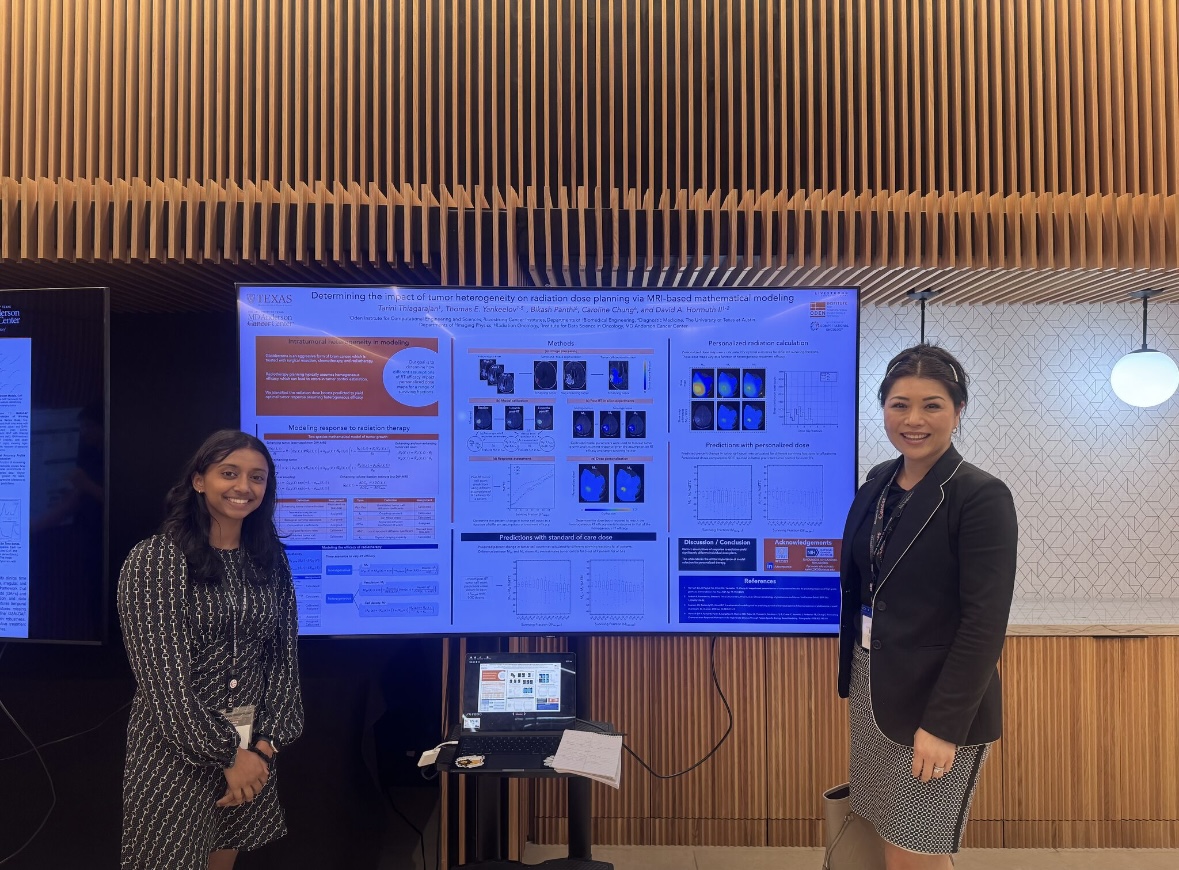
Tarini Thiagarajan wanted to help people through medicine from a young age. What she didn't know was what that would actually look like. A high school health science course for pre-med students gave her the first hint that the traditional path of becoming a medical doctor, and specifically the oncologist she had always dreamed of being, might not be hers. "It was not what I had expected," she said. "I quickly realized I wasn't as excited by the traditional pre-med path as much as I thought I would be."
Her father nudged her toward engineering, pointing to the advanced math and physics courses she had consistently thrived in. She took his advice and enrolled at The University of Texas at Austin. Her interest in cancer had already been sparked by the time she arrived.
In 2018, Dr. James P. Allison and Dr. Tasuku Honjo received the Nobel Prize for their work in immune checkpoint therapy, a treatment approach that enlists the body's own immune system to fight cancer. The news caught her attention and drew her toward cancer research. "Immunotherapy fascinated me," she said. "I really wanted to learn more about it and maybe do work similar to Dr. Allison."
As she explored college options, she came across research by Professor Tom Yankeelov, director of the Center for Computational Oncology at the Oden Institute for Computational Engineering and Sciences, and realized she had a found a field that truly resonated with her. Here was someone using mathematics to understand how cancer behaves in the human body and in a light-bulb moment, Tarini realized she didn’t have to choose between the two things she loved. During her sophomore year in college, Yankeelov and Oden Institute research scientist David Hormuth took a chance on her. "The rest is history," she said. She laughs now about how things turned out. "I guess I decided to become a different kind of doctor than I had initially expected."